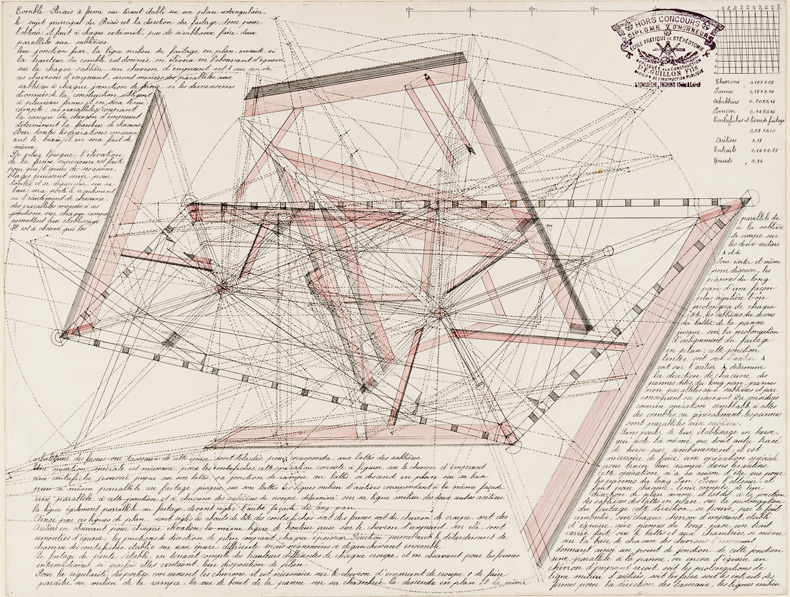
L’art du Trait (or The art of Geometry) is the name given to a form of carpentry which has existed since the middle ages through the Federation Compagnonnique, an organisation dedicated to the continuation of trades within and unique to France. The path of the charpentier involves training with master carpenters around France, and finally producing a “masterpiece” to signify the end of training, and the attainment of a high level of skill using the techniques which have been passed down to them.
French charpentieres produce highly complex, curved wooden forms, primarily as roofing and timber framed structures. The pieces are designed without relying on numerical measurements, and are instead created using the rules of geometry, which often leads to to concentric, repeating patterns, like a mandala extruded through 3D space. The intersecting curves and beams require complicated and precise joinery, and the skill of the charpentier is in translating the original geometric form into a discrete number of parts that can be assembled to produce the final piece. The forms are designed using a particular kind of orthographic drawing which can be extremely confusing to the untrained eye, but to an experienced charpentier they describe the volumes and curves of the 3 dimensional structure in detail, and provide all the information required to construct the piece.
Trait carpentry is an impressive piece of history and culture, however the highly decorative and handcrafted work is in contrast with the global trend of mass production and standardisation. This trade cannot compete with the pace of building with modern materials and tools and it’s place in the modern world is therefore threatened, but the long history and tradition of trades like this can, and do inform modern design practices. The genius of this work is that a few simple parts can be designed on paper, and then be produced in multiples to come together to create intricate and sculptural creations, greater than the sum of their parts.


 Handmade